


Stocks To Buy Now : AI Signals
4.2443.00 Reviews
App Specs
- Version
- 3.22.44
- Updated On
- License
- Free
- Downloads
- 50,000+
- Developer
- Stocks to Buy Now ai
- Categories
- Finance
- Platform
- Android, iOS
Screenshots

 Analysis by AppCompare
I approached Stocks To Buy Now: AI Signals as a research companion rather than a magic stock picker. That distinction matters. This free finance app, created by Stocks to Buy Now ai, is built around market signals and AI-assisted ideas, so its most useful role is helping me organize questions before I make an investment decision. It is not a replacement for judgment, a brokerage account, or a complete financial plan.
My first impression was that the app makes more sense when I treat every signal as a starting point. A highlighted opportunity can be useful for discovering a company or comparing market activity, but it still needs context: the business, valuation, industry conditions, risk level, and my own time horizon. The best habit is to use the app to narrow research, not to outsource the decision.
How I built a practical research routine
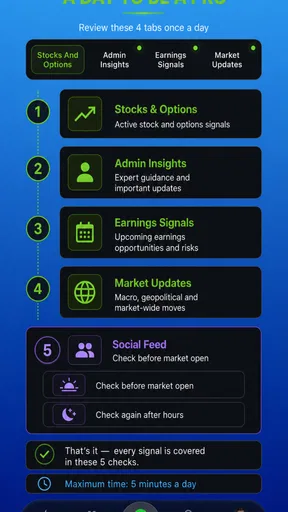
The simplest workflow is also the one I trust most. I open the app when I have a specific research task, review the available market signals, note which ideas deserve attention, and then verify them elsewhere before acting. That keeps the experience focused and prevents a stream of suggestions from turning into impulsive trading.
For example, imagine I have money available for a long-term investment and want to explore companies in a particular area. I would use the app to surface candidates, then write down why each one appeared interesting. After that, I would compare the candidates with company filings, reputable financial news, and a brokerage platform before deciding whether any belongs on my watchlist. The app is helpful at the discovery stage, while those other tools are better for confirmation and execution.
This workflow also answers an important question: is it suitable for beginners? I think it can be, provided a new investor understands that an AI-generated signal is not a guarantee. Beginners may appreciate having a structured list of ideas instead of searching randomly, but they should avoid buying simply because an item looks prominent or urgent. A basic understanding of diversification, fees, volatility, and risk should come before putting real money behind any suggestion.
Experienced users can make the process more repeatable. Rather than checking whenever the market feels exciting, I would use a consistent review session, record the date and reason for each candidate, and revisit the original thesis later. This reduces hindsight bias. If an idea works, I can see whether my reasoning was sound; if it fails, I can identify whether the signal, my interpretation, or the market environment was the problem.
The app’s free entry point makes this kind of experimentation easy. I can test whether its signals fit my way of researching without committing immediately to a paid service. At the same time, the presence of in-app purchases ranging from around eight dollars to nearly four hundred dollars per item means I would examine any upgrade screen carefully before accepting a charge. The free label should not be confused with every feature being free.
Worth Reading Before You Choose

Flipboard Shows What News Apps Must Do Beyond the Feed

Switching to Android Auto Means Rethinking Your Driving Routine

Google Calendar Makes a Crowded Week Easier to Manage

Ludo King Makes the Most of the Minutes Between Plans

Baby Panda World Brings Quick Play to Modern Phones, but Its Game Library Feels Busy

ESPN’s Live Game View Makes Following Close Games Easier
What I check before trusting a signal
I do not judge a signal by its direction alone. A positive-looking suggestion can still be unsuitable if the company is too volatile for my goals, if the sector is already crowded, or if I would be unable to tolerate a large short-term decline. I also ask whether the idea fits a diversified portfolio rather than adding more exposure to something I already own.
Another useful check is timing. A signal may be interesting today but less relevant when I am ready to invest. I prefer to treat it as a snapshot that prompts fresh research, not as a permanent recommendation. This is especially important in fast-moving markets, where news can change the outlook between one review session and the next.
I also separate discovery from action. During the first pass, I collect possibilities without buying. During the second pass, I challenge each idea and look for reasons it might be wrong. Only after that would I consider an order through a separate investing platform. This two-stage habit is more valuable than trying to react faster to every update.
Settings and choices worth reviewing
Because the experience centers on signals, I would spend time understanding how the app presents them before relying on the results. The important questions are practical: what market or asset is being discussed, what period the signal seems to address, and whether the item is meant for observation or immediate attention. If the wording feels too vague, I treat that as a reason to investigate rather than fill in the gaps myself.
I would also check the app’s account and purchase areas before doing serious research. The developer is listed as Stocks to Buy Now ai, and the product is rated for mature users aged seventeen and above. That age classification is a reminder that this is an investment-oriented tool, not a casual game or a simplified savings tracker. Anyone using it should be comfortable handling financial information responsibly.
Notifications deserve a deliberate approach too. If the app offers alerts on a device, I would avoid allowing every possible prompt to interrupt the day. Constant alerts can create the illusion that every movement requires action. A calmer setup is better: review information at a chosen time, then decide whether it changes a long-term thesis. If an alert encourages immediate buying without enough context, I would mute it or ignore the pressure.
I would not assume that an AI label means the app understands my complete financial situation. Unless I have independently supplied and evaluated that context, the signal cannot know my emergency fund, tax position, existing holdings, debt, or tolerance for loss. That is one of the clearest limits of this kind of tool. It may analyze market information, but it does not automatically turn a general idea into personal financial advice.
Another setting-related habit is to keep the app in its proper role on my phone. I would place it alongside my other research tools rather than treating it as the only investing destination. A brokerage app is designed for orders and account management; a financial news service provides broader reporting; a spreadsheet or notes app helps track decisions. This product fits best between those tools, as an idea generator and signal dashboard.
Faster patterns that do not sacrifice judgment
The quickest useful pattern I found is a three-pass review. First, I scan for ideas that match my current research topic. Second, I remove anything that conflicts with my risk limits or portfolio balance. Third, I investigate only the small group that survives. This is faster than opening every suggestion, and it prevents the app from dictating my priorities.
A second pattern is to create a written “why” before looking for a price target. I might note that I am researching a company because of its industry position, improving results, or a specific business change. Then I can ask whether the signal adds evidence to that thesis or merely attracts attention. If I cannot explain the reason in plain language, I am probably not ready to act.
I also like using a watchlist-style mindset even when I am not buying. A candidate can remain under observation while I wait for more information, compare it with alternatives, or decide that it is not appropriate. This is a practical way to reduce FOMO. A missed trade is usually less damaging than a poorly understood purchase made under pressure.
For a realistic everyday scenario, I might check the app during a weekly personal finance session. I would review new ideas for a limited amount of time, select two or three for deeper reading, and then update my notes. If one appears attractive, I would compare it with what I already own and ask whether the new position improves diversification. If the answer is no, the correct action may be to do nothing.
This approach also makes the app more useful for experienced investors. Someone who already follows markets can use it as a second opinion or a way to notice companies outside a familiar list. The value is not that the app eliminates research; it is that it may challenge a narrow routine. Still, an experienced user should be just as skeptical as a beginner, because familiarity with markets can create overconfidence.
The app has a 4.2 average from around one and a half thousand ratings, with more than four hundred written reviews. I read those figures as evidence that many people find the concept useful, not as proof that every signal will suit every portfolio. User approval can tell me that the experience is accessible, but it cannot validate a particular investment outcome.
Where the app is genuinely useful
Its strongest use case is idea discovery. If I am overwhelmed by the number of listed companies or unsure where to begin, a signal-based interface can give my research a direction. It is also useful when I want to compare several possibilities without starting from a blank page. The AI framing may help turn a broad question into a shortlist, which is a reasonable convenience.
It can also support learning if I use it actively. Instead of accepting a suggestion, I can ask what made it interesting, investigate the related company, and compare the signal with my own conclusion. Over time, this teaches me to recognize the difference between a market event, a trend, and a durable investment thesis.
The product’s reach is notable as well: it has passed fifty thousand installs. That makes it more established than an obscure personal project, although popularity still does not remove the need for careful financial checks. I would be comfortable testing it as a research aid, but I would not interpret its install count as a recommendation to invest.
It may be especially helpful for people who want a compact mobile starting point. Someone who already has a separate brokerage account can use this app for exploration and then move to a more appropriate service for execution. That separation is healthy. The app does not need to perform every financial task to be worthwhile.
Where conventional alternatives are better
If I need detailed company financials, portfolio allocation, tax documents, order types, or account performance, I would choose a brokerage platform or a dedicated research service instead. Those tools are designed for depth and record keeping. A signal-focused app can point me toward a question, but it is not the place I would expect to complete every part of due diligence.
It is also not my first choice for passive investors whose main goal is regular contributions to diversified funds. In that situation, a simple investment plan and a low-cost brokerage may be more appropriate than a stream of individual stock ideas. The app could add distraction without improving the strategy.
Short-term traders should be cautious too. Faster decisions require reliable execution, clear market data, and a well-tested risk system. A signal alone is not enough to manage entries, exits, position sizing, or sudden price gaps. Anyone seeking that level of precision should use tools built specifically for active trading and understand their limitations before risking money.
Advanced limits I would keep in mind
The biggest limitation is interpretation. “AI-powered” sounds precise, but a signal still needs a human explanation. If I cannot tell what evidence supports an idea, how current it is, or what could invalidate it, I do not consider it actionable. A polished interface can make uncertainty feel smaller than it really is.
There is also a risk of confirmation bias. I might open the app hoping to find support for a stock I already like and then treat a favorable signal as independent proof. To avoid that, I would deliberately search for contrary information after every appealing result. The app is more valuable when it broadens my questions than when it confirms my existing enthusiasm.
Paid features require similar discipline. Since individual in-app purchases can become substantial, I would compare the cost with how often I actually use the research. A frequent investor may find a premium workflow worthwhile, while an occasional saver may get enough value from the free experience or prefer public research sources. I would never upgrade merely because a screen presents a limited-time feeling of urgency.
The technical requirements are modest for a modern Android device: the app supports Android six point zero and later, and its current version is 3.22.44. That makes it accessible on many older phones, though I would still keep the operating system and app updated when possible. Financial apps deserve extra care around device security, screen locks, and account protection, regardless of how simple the interface appears.
Another limitation is emotional rather than technical. Market signals can encourage frequent checking, especially after a position moves against me. I would set a schedule and stick to it. If the app becomes a source of anxiety or makes me trade more often than planned, it is no longer helping. The right tool should support a process, not replace one.
My verdict after using it as a disciplined tool
I see Stocks To Buy Now: AI Signals as a convenient research companion for people who want help finding investment ideas. Its free starting point, mobile format, and signal-oriented approach make it approachable, while the developer’s focus is clear from the product itself. The app is most convincing when I use it to create a shortlist and then do the harder work elsewhere.
I would recommend it to a curious beginner who is willing to learn, an investor looking for a second source of ideas, or someone who wants a repeatable way to begin market research. I would not recommend relying on it alone, following signals automatically, or using it as a substitute for a diversified plan. The mature age rating is appropriate because real financial decisions carry real consequences.
My final routine would be simple: review signals on a schedule, check the relevant settings and purchase screens, write down the reason for each candidate, challenge the idea with independent research, and use a separate platform for any transaction. That process turns the app from a source of tempting prompts into a useful filter.
My bottom line is that the app is worth trying for discovery, not for blind decisions. If you already understand its limits, it can make the first stage of stock research quicker and more organized. If you want guaranteed picks, complete portfolio management, or professional-level trading tools, I would choose a different solution. Its real value appears when my own judgment remains in charge.
Pros
- AI-generated signals help identify potential stock opportunities quickly.
- Simple interface makes market insights accessible to newer investors.
- Useful watchlist tools help track selected stocks in one place.
- Signals can save time compared with manually screening many companies.
- Supports faster research before making independent investment decisions.
Cons
- AI predictions can be inaccurate
- especially during sudden market volatility.
- Signals should not replace thorough research or professional financial advice.
- Some features or insights may require a paid subscription.
- Frequent alerts could encourage emotional or overly active trading.
- Stock data and recommendations may not always update instantly.
FAQs for Stocks To Buy Now : AI Signals
What is Stocks To Buy Now: AI Signals?
Stocks To Buy Now: AI Signals is a market-analysis app designed to help users research potential stock opportunities using artificial intelligence, market data, and signal-based insights. It may highlight stocks that appear interesting according to selected indicators, trends, or algorithmic evaluations. The app should be treated as a research and educational tool rather than a replacement for professional financial advice or independent investment analysis.
How reliable are the AI stock signals?
AI signals can be useful for discovering ideas and reviewing market patterns, but they are not guaranteed predictions. Stock prices are influenced by news, economic events, company performance, investor sentiment, and unexpected market movements. During testing, users should understand that a signal may become outdated quickly or produce a loss. Always check the underlying company information, valuation, risk level, and current market conditions before making an investment decision.
Is Stocks To Buy Now: AI Signals suitable for beginners?
The app can be helpful for beginners because it presents stock ideas and market indicators in a more accessible format than many advanced trading platforms. However, new investors should not follow recommendations blindly. Before using any signal, learn the basics of diversification, volatility, fees, order types, and risk management. Beginners may want to use the app for research first and consider simulated investing before committing real money.
Can I buy or sell stocks directly through the app?
Stocks To Buy Now: AI Signals is primarily intended to provide market information and AI-generated signals, so its features may differ from those of a brokerage platform. Depending on the version and region, it may not execute trades or hold investments directly. Users should review the app’s current feature list and privacy or subscription details, then use a properly regulated broker if they decide to place orders.
Does the app cost money, and are there subscriptions?
The availability of free features, premium signals, trials, or recurring subscriptions can vary according to the app version, device, and location. Before downloading or activating a trial, carefully review the pricing page, billing frequency, renewal terms, and cancellation instructions. A subscription should not be judged only by the number of signals provided; also consider data quality, transparency, usability, and whether the service fits your investment research needs.


